
5 Ways to Build an AI Agent for Your Business
As the market cap of legacy software platforms plummet, it feels like everyone now believes the future is commercial operations leaders creating AI agents that do the work we used to pay these software platforms for.
Right now, I’m watching many commercial leaders waste time on AI. There’s a huge amount of experimentation as we all try to figure out what agentic AI means for our business. 95% of those experiments are not delivering a positive ROI; but maybe that’s okay as we need to go through this phase of learning.
But it feels like soon we need to start locking in on systems that we can rely on for at least the next 6-12 months. For sure, we’re not advising anyone to lock in on multi-year software licences right now, but we can’t stand still either.
Let’s get back to basics. Before we start figuring out how to create an AI co-worker, let’s figure out where we can leverage AI capabilities to unlock value across the business. The first questions we need to ask are like these:
Where are we spending time that feels like it’s time not well spent?
Where are we providing inconsistent outputs at scale?
Where is the process taking way too long to execute?
Where are we struggling to hire for entry-level roles?
Where is there complex analytics and data gathering required?
Until you can identify and quantify the friction, you are window shopping in the wrong stores. You’re in danger of ending up with fancy systems that don’t address the real pain in your business.
Once you’ve identified your target process leaks, the next decision is architectural. There are at least 5 different way to address these gaps with AI agents, but the choice depends on your strategy.
Is this a clearly defined, repetitive workflow we can safely experiment on without deep system integration?
Do we need intelligence embedded inside our existing systems, but still under deterministic, controlled workflows?
Is AI becoming a core part of our competitive advantage that we cannot afford to outsource or treat as a bolt-on?
Are governance, security and ecosystem alignment more important than speed of experimentation?
Is there a clearly measurable functional role where we want fast ROI more than architectural ownership?
That answer determines the architecture and approach. Park the hype around specific new feature releases. Your architectural approach matters more than the vendor right now.
We see five broad approaches:
Visual Agent Builders - Fast, low-code tools for automating clearly defined workflows without deep engineering involvement.
Workflow Automation + AI - AI layered into structured, deterministic workflows to improve execution inside existing systems.
Custom Agent Frameworks - Developer-led infrastructure for building proprietary, deeply integrated AI capabilities.
Enterprise Agent Platforms - Governed AI environments embedded inside large-scale enterprise ecosystems.
AI Co-Workers - Outcome-focused AI packaged as functional roles, prioritising speed to ROI over architectural ownership.
Let’s dig in.
1. Visual Agent Builders
Visual Agent Builders are fast, low-engineering tools for automating contained processes like tier-one support or inbound qualification. There’s a pletorah of emerging platforms such as Voiceflow, Botpress, Vellum and Kore.ai in a new category that exists because business teams no longer want to wait for engineering.
When you want speed inside a clearly bounded workflows, solutions like this promise fast deployment, visual logic, quick integration and minimal code. They work well when the process is structured and risk is contained.
Tier-one customer support is a great example. You have high ticket volume, repetitive questions and a reasonably clean knowledge base. You deploy an agent to handle defined scenarios, escalate when confidence is low and measure containment rate, response time and cost per resolution.
Another use case is inbound lead qualification. The criteria are clear. The outputs are structured. You can measure meeting conversion and time-to-response. This approach enable rapidly-deployed and low-risk experimentation. It can produce meaningful efficiency gains quickly.
Where it breaks is predictable. If documentation is inconsistent, the agent amplifies inconsistency. If edge cases dominate, flows become brittle. If nobody owns maintenance, the system decays quietly.
And once workflows become complex, cross-system and revenue-critical, visual logic starts to strain. These tools are ideal for shallow integration and learning. They are not deep operational infrastructure.
2. Workflow Automation + AI
You already have well defined and automated workflows. Now you can deploy mini-agents at key points to drive productivity. Platforms such as Zapier, Make, n8n and Workato began as workflow engines and have now made it super-easy to layer in AI via direct integration with the major LLMs.
This category exists because many commercial systems are already structured. CRM, marketing automation, billing and support platforms are connected by workflows. No when intelligence needs to sit inside deterministic systems, you do not need autonomy, rather you need smarter execution.
A practical use case might be sales or client call administration. Calls are transcribed. An AI step extracts structured data and updates CRM fields. Reps recover hours per week. Managers get cleaner pipeline data.
Another common use case is inbound lead routing. Submissions are enriched, classified and routed automatically. Response time improves. Conversion improves.
But here is where we need to be cautious. If you allow AI outputs to update revenue-critical data without validation logic, you risk contaminating forecasting and reporting. Annoyingly, inconsistency remains with AI outputs without very precise limited use cases. A small error rate at scale can distort decision-making.
In addition. workflow complexity can grow quickly. What begins as three steps becomes fifteen. Debugging becomes difficult. And these tools do not automatically evaluate whether your AI logic is improving or drifting. You must build validation and monitoring deliberately.
This approach offers speed to launch, more control and moderate integration depth. It can deliver measurable efficiency quickly. But it is not autonomous agency. It is deterministic workflow with intelligence embedded.
3. Custom Agent Frameworks
When you build with frameworks, you start to own the architecture and make AI part of your strategic capability. Think of these as orchestration layers that enable you to engineer agents connected to multiple systems. LangChain (and LangGraph), LlamaIndex, Microsoft’s Agent Framework combining Semantic Kernel and AutoGen, plus CrewAI and are not experimentation tools. They are infrastructure choices.
You move here when AI is central to differentiation. For example, building a proprietary pricing optimisation engine that ingests CRM data, win-loss patterns, competitor signals and margin constraints, and generates structured recommendations. Or embedding an AI commercial strategy layer directly into your SaaS product as part of customer value.
This is deep integration. It requires engineering capability, evaluation pipelines, observability tooling and operational discipline. Feedback loops must be designed. Model performance must be measured over time. Time-to-value is longer. This is not a quarterly ROI experiment. It is a capability investment.
What often breaks here is not technical feasibility. It is commercial impatience. Boards expect immediate impact. Strategic infrastructure requires sustained commitment. If AI is your moat, this is the conversation you should be having. If you are chasing incremental efficiency, this is probably too heavy.
4. Enterprise Agent Platforms
When governance and political reality dominate platforms such as Microsoft Copilot Studio, Salesforce Einstein and Agentforce, ServiceNow AI, Amazon Bedrock Agents and Google Vertex AI Agents exist because autonomy without governance is unacceptable in large organisations.
These agentic systems integrate deeply into enterprise ecosystems. Security, audit logs, access controls and compliance frameworks are built in. In practice, this often looks like augmentation first. Copilots assisting inside Microsoft 365. AI suggestions embedded inside Salesforce. Automated service workflows inside ServiceNow.
Full autonomy usually comes later, if at all.
You gain executive comfort and compliance alignment. You lose speed and flexibility. Licensing costs scale. Procurement cycles lengthen. Innovation moves at the pace of governance.
This is deep integration, but inside predefined boundaries.
Commercial leaders inside enterprise environments must align expectations accordingly. Enterprise AI often begins as assistance, not replacement.
5. AI Co-Workers
Currently high on the hype curve. This is outcome-first AI packaged as a role, trading ownership for speed for when autonomy is packaged into measurable functional outcomes.
At the infrastructure level, model providers are enabling agents capable of planning, tool use and multi-step execution. From Anthropic’s Claude Cowork as a co-worker, to OpenAI’s Operator and GPT agents, Google’s Gemini-powered workspace agents, and Microsoft Copilot across M365.
On top of that, vendors package autonomy into roles. Think of Intercom Fin for support, Ada’s AI support agent, 11x and Regie for AI SDRs, Harvey for legal, Hebbia for research, Sierra for customer operations, and Glean for enterprise knowledge work.
These vendors sell outcomes, not architecture. Support cost per ticket resolved. Meetings booked per month. Research hours reduced. This is often the fastest path to visible ROI.
But experienced operators will recognise the risks. Quality drift can damage brand perception. Contextual nuance is sometimes lost. Over-automation in pursuit of cost savings can erode customer experience. Vendor dependency may feel uncomfortable if the function becomes strategically central.
This is moderate-to-deep functional integration, but with outsourced control. Speed now. Ownership trade-offs later.
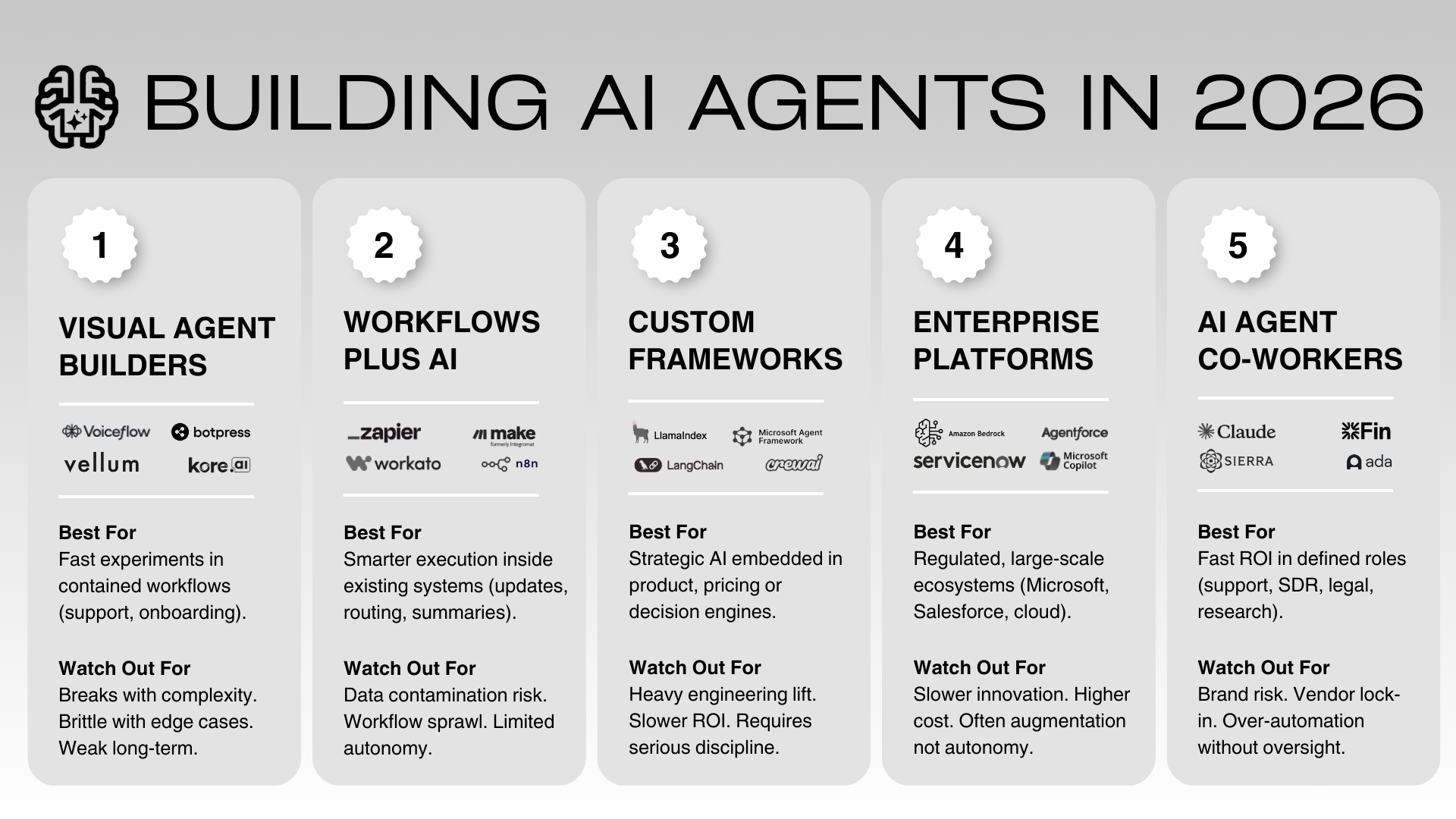
Choosing the Right Architecture
What’s happening right now is not just a tooling cycle. It’s a structural shift. For the last fifteen years, we bought software platforms and configured workflows inside them. We adapted our processes to fit the system. Now the system can adapt to us.
That is the promise of agentic AI.
But that promise only becomes commercial leverage if we stop treating AI as a feature and start treating it as operating architecture. The drop in legacy SaaS valuations is not just a market correction. It’s a signal. The value is moving from static systems of record to dynamic systems of execution.
The question is not whether agents will matter. The question is how deliberately you design their role inside your business. If you chase co-workers without identifying process friction, you will automate noise. If you embed AI into workflows without thinking about data integrity, you will corrupt decision-making. If you build infrastructure without strategic patience, you will abandon it halfway through. If you hide inside enterprise platforms without challenging process design, you will augment mediocrity.
Every one of the five approaches we’ve discussed is valid, in its place.
Visual builders are powerful when you need speed and bounded experimentation.
Workflow automation plus AI delivers measurable efficiency inside structured systems.
Custom frameworks enable long-term differentiation if AI is part of your moat.
Enterprise platforms provide governance where political and regulatory constraints dominate.
AI co-workers can drive fast functional ROI when the output is measurable and contained.
The mistake is not choosing the wrong vendor. The mistake is misaligning architecture with intent. Right now, most commercial teams are experimenting. That’s fine. Learning is necessary.
But the next phase is commitment. Not five-year lock-in. Not blind hype. But deliberate architecture decisions aligned to clearly defined commercial pain.
Identify the friction. Quantify it. Decide your integration depth. Then choose the architecture that matches your ambition.
